
Dropshipping is a way to sell products online without having to keep them in stock. This guide will show you how to start and grow a dropshipping business with a good marketing and search engine optimization plan.
The executive summary of this guide is that dropshipping is still a way to make money online in 2026. The global market for dropshipping is expected to reach $476.1 billion by 2026. This guide will give you a plan for building, growing and making the most of a profitable dropshipping business with actionable marketing and search engine optimization strategies.
What is Dropshipping?
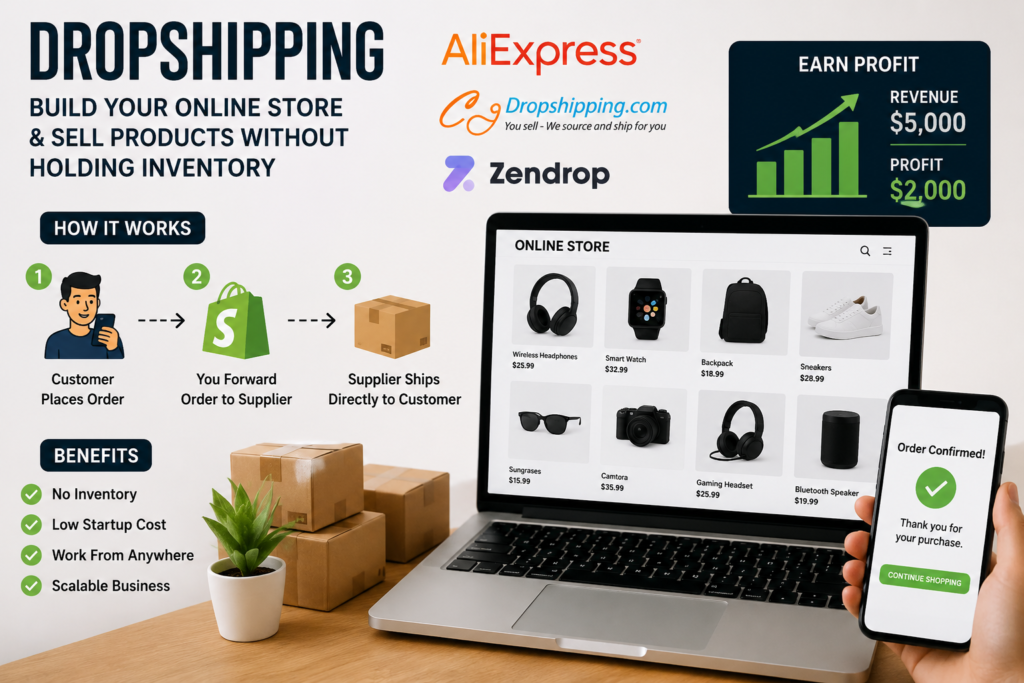
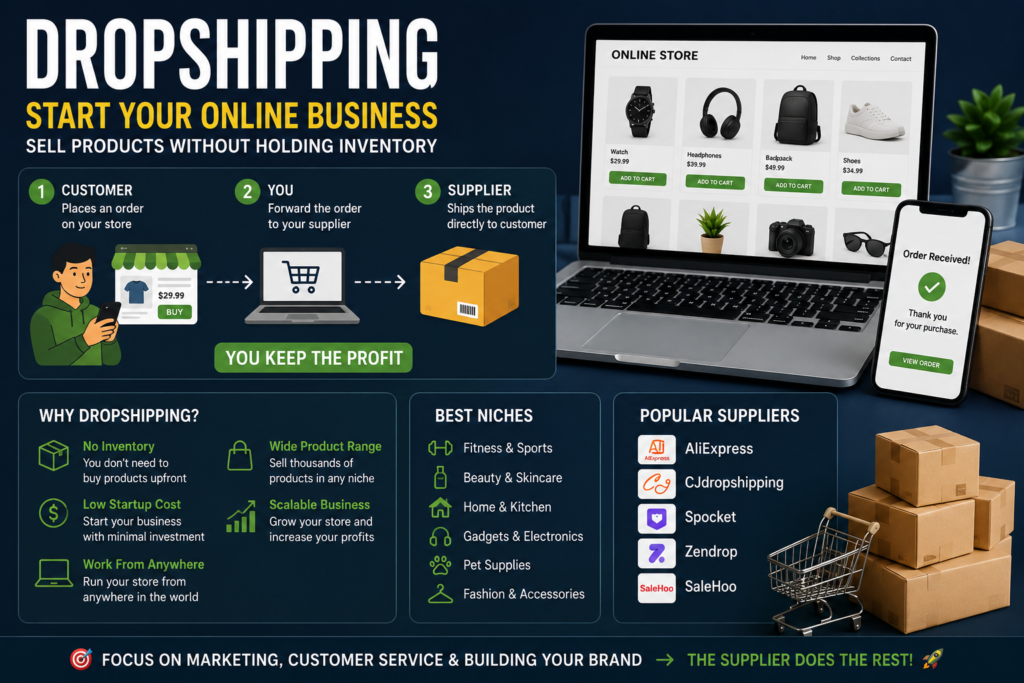
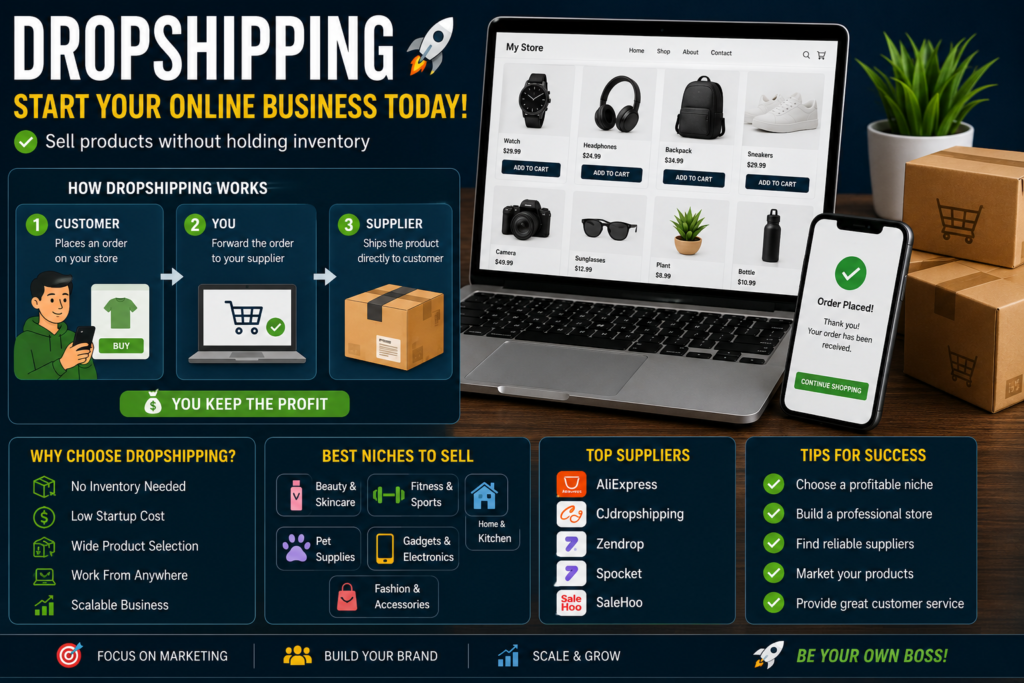
Dropshipping is a way to sell products without having to keep them in stock. When a customer buys something from you you send the order to a supplier who ships the product directly to the customer. The money you make is the difference between the price you sell the product for and the price the supplier charges you.
The good things about dropshipping are:
- It does not cost a lot to start.
- You can do it from anywhere.
- You can sell a range of products.
- It is easy to grow your business.
The challenges of dropshipping are:
- The profit margins are low between 15% and 30%.
- There is a lot of competition in markets.
- You have limited control over the quality of the products and shipping.
- It can be hard to provide customer service.
To find markets you need to look for areas with these characteristics:
- Products that solve problems for customers.
- Markets with customers who are looking for solutions.
- Products that can be sold for $30 to $200 with a profit margin of 30% or more.
- Keywords that are not too competitive with a difficulty score of than 40.
- Markets that are growing in popularity
Some markets that might be profitable in 2026 are:
- Products that are good for the environment.
- Smart home. Accessories.
- Products for pets that’re good for their health.
- Home fitness and wellness equipment.
- Products that can be personalized.
- Supplies for hobbies like art and gardening.
Building Your Dropshipping Store
To start a dropshipping business you need to choose a platform to sell on. Shopify is a choice because it has a lot of features and can be integrated with other tools. You can also use WooCommerce or BigCommerce.
Your store needs to have these elements:
- A professional brand with a logo, color scheme and story.
- A design that works well on devices.
- Signs that show your store is trustworthy such as customer reviews and security badges.
- High-quality product images.
- Product descriptions that focus on the benefits of the product.
To get sales you need to optimize your product pages with these elements:
- Prominent buttons to buy now.
- Signs that show when a product is running out of stock.
- Customer reviews with photos.
- Clear information about shipping times and costs.
- Guides to help customers choose the size.
- A section for asked questions.
- Live chat. A chatbot.
Search Engine Optimization Strategy
To get traffic from search engines you need to do these things:
- Research keywords that have intent and are not too competitive.
- Use a structure for your keywords like ” product type for specific use case”.
- Create content that is optimized for search engines, such as category pages and product descriptions.
- Use a checklist to make sure your site is fast mobile-friendly and secure.
Content Marketing Strategy
To build authority and get traffic you need to create content that is valuable to your customers. You can use these types of content:
- Ultimate guides that are resources.
- Product comparisons that help customers make decisions.
- Step-by-step guides that show customers how to use your products.
- Industry. Thought leadership.
- Customer. Case studies.
You should publish content regularly such as 2-3 blog posts per week. Use a mix of promotional and educational content.
Paid Advertising Framework
To get sales you need to use paid advertising on platforms like Facebook and Instagram. You can use these strategies:
- Target audiences with interests and behaviors.
- Use lookalike audiences to target customers who’re similar to your existing customers.
- Retarget customers who have visited your site but have not bought anything yet.
- Use dynamic product ads to target customers who have abandoned their cart.
You should also use best practices like user-generated content, problem-agitation-solution framework and strong hooks in the first 3 seconds of your ads.
Budget Allocation
You should allocate your budget in this way:
- 60% to proven winning ads.
- 30% to scaling campaigns.
- 10% to testing creatives.
Google Ads Strategy
You can also use Google Ads to get sales. You can use these campaign types:
- Shopping ads that target high-intent keywords.
- Search ads that target branded and commercial keywords.
- Display retargeting ads that target customers who have visited your site but have not bought anything yet.
You should aim for a return on ad spend of 3.0 or more. Adjust your budget allocation accordingly.
Supplier Selection and Management
To find suppliers you need to evaluate them based on these criteria:
- Product samples that are of high quality.
- Average shipping time that is than 14 days.
- Communication that is responsive and helpful.
- Order accuracy rate that is 95% or higher.
- Packaging that is of quality and can be branded.
- Return and exchange policies that are fair.
You can use supplier platforms like AliExpress, Spocket, CJ Dropshipping, Modalyst and SaleHoo to find suppliers.
Building Supplier Relationships
To get terms from your suppliers you need to negotiate with them after you have proven that you can sell a lot of their products. You can ask for:
- Faster processing times.
- Branded. Inserts.
- Exclusive products.
- Volume discounts.
- Priority support.
Marketing Channels and Customer Acquisition
To get customers you need to use these marketing channels:
- Email marketing automation that sends emails abandoned cart emails and post-purchase emails.
- Influencer marketing that partners with influencers who have a niche audience.
- Affiliate marketing that offers commissions to affiliates who promote your products.
- Social media marketing that uses platforms like Instagram, TikTok, Pinterest and YouTube.
You should track your performance metrics, such as conversion rate, average order value, customer acquisition cost return on ad spend, email open rate and cart abandonment rate.
To calculate your profit you need to use this formula:
Revenue = Units Sold x Selling Price
COGS = Units Sold x (Product Cost + Shipping)
Marketing Spend = Ad Spend + Influencer Costs + Tools
Operating Expenses = Shopify + Apps + Customer Service
Net Profit = Revenue. COGS. Marketing. Operating
You should aim for a profit margin of 15-25% for a healthy dropshipping business.
Scaling Your Dropshipping Business
To grow your business you need to go through these phases:
- Phase 1: Validation (Months 1-3). Launch with 10-25 products, test Facebook and Instagram ads and focus on proving product-market fit.
- Phase 2: Growth (Months 4-8). Expand to 50-100 products scale winning ad campaigns launch email marketing automation and start content marketing and search engine optimization.
- Phase 3: Optimization (Months 9-12). Optimize conversion rates, diversify traffic sources, launch affiliate program and consider labeling top products.
- Phase 4: Expansion (Year 2+). Expand to product lines or niches private label own branded products consider holding inventory, for bestsellers and build a team.
Common Pitfalls to Avoid
To avoid mistakes you need to:
- Choose a niche that is not too competitive.
- Vet your suppliers carefully to ensure they are reliable.
- Provide customer service to build trust and loyalty.
- Differentiate your store from competitors through branding and marketing.
- Monitor your profit margins to ensure you are making a profit.
- Build an email list to reduce your reliance on paid ads.
- Use branding to build trust and credibility.
- Do market research to validate your product ideas before launching.
Legal and Compliance Essentials
Required Pages:
- Privacy Policy that meets the GDPR rules
- Terms of Service
- Refund and Return Policy
- Shipping Policy
- Contact Information
Business Structure:
- Register your business as an LLC to protect yourself from lawsuits
- Get a business license in the area where you live
- Open a bank account for your business
- Keep track of your expenses so you can do your taxes
Tax Considerations:
- Learn about sales tax and where you need to pay it
- Use tools like TaxJar or Avalara to make taxes easier
- Talk to an accountant to make sure you are doing everything
Action Plan for the Next 30 Days
Week 1 is about building a strong foundation.
- Choose a niche that you think will work based on your research
- Set up a Shopify store with a theme that looks professional
- Register your business. Get the licenses you need
- Order samples from 3 to 5 suppliers to see what they can do
Week 2 is about setting up your store.
- Add 15 to 20 products with descriptions that’re unique
- Install apps that are essential like reviews and email and analytics
- Create pages that build trust like About and FAQ and Policies
- Set up Google Analytics and Facebook Pixel to see what is working
Week 3 is about getting ready for marketing.
- Create social media accounts with content that looks like your brand
- Set up email marketing with a message
- Make ads with versions
- Write your 3 blog posts with keywords that people search for
Week 4 is about launching and testing.
- Start running Facebook and Instagram ads with a budget of 20 dollars a day
- Post on media every day
- Send reminders to people who did not finish their order
- Get your orders and ask for feedback
- Look at the data. Make changes to improve
- Keep doing this to make it better
Recommended Tools and Resources
- Shopify is a platform for e-commerce and you can upgrade to Plus or Advanced as you grow
- Klaviyo and Omnisend are good for email marketing
- Canva Pro and CapCut are good for making ads
- Ahrefs and Semrush and Keywords Everywhere are good for SEO
- Google Analytics 4 and Hotjar are good for analytics
- Gorgias and Zendesk are good for customer service
- SaleHoo and Niche Scraper are good for product research
- QuickBooks and Xero are good for accounting
Final Thoughts
To be successful in dropshipping in 2026 you need to do more than just set up a store and run ads.
Dropshipping success in 2026 requires a combination of things.
Dropshipping success in 2026 is about choosing a niche that people want and making a brand that looks professional.
Dropshipping success in 2026 is about marketing on channels and taking care of your customers.
Dropshipping success in 2026 is about using data to make decisions and thinking term.
Start small. Test quickly and make changes to what works and always put your customers first.
The stores that do well are the ones that treat dropshipping like a business and not a way to get rich quick.
You have to be patient and keep working at it to make it successful.
Dropshipping success in 2026 is, about doing all these things and more.